15 stages · 845 km

Gradients and elevation

Ascents: 18366m
Descents: 18795m
Lowest point: 2m
Highest point: 1586m

Road types

457km (54%) By road
270km (32%) Cycle path

Surface

43km (72%) Smooth
63km (106%) Unknown
13km (22%) Unpaved

15 stages used

Thonon-les-Bains / Annemasse

1 Thonon-les-Bains / Annemasse

60 km
4 h 00 min
Difficult
The adventure begins in Haute-Savoie, on the town hall square in Thonon-les-Bains. More precisely, from the km 0 sign on the Route des Grandes Alpes®, the starting point for all major Alpine crossings (hiking, cycling, mountain biking).
You then leave the shores of Lake Geneva and head out of town towards the Col du Feu (1120 m), the first obstacle on the route. Up to the pass, the route is shared with the Route des Grandes Alpes® Gravel. The ascent of the Col du Feu, where the Tour de France 2023 passed through, is fairly short but rather tough. Including the final section on the road, where you'll find a 10% gradient. Beautiful panoramic views of Lake Geneva and the Chablais massif at the summit.
From the pass, pleasant paths wind through a green, perched valley to the Col des Moïses aerodrome (1121 m), reserved for gliders. The Menoge, which you'll be following, rises in nearby marshland. At first, you drive a little away from its right bank on a forest track. After passing Habère-Poche, you rejoin the stream at Habère-Lullin. The trail is well laid out and very pleasant. There are many changes of direction which slow down progress. Those in a hurry can take the road.
The banks of the Menoge lead to Boëge, then Bonne. At the crossroads with the D1205, you're very close to Vétraz-Monthoux and the Annemasse conurbation, where you'll find accommodation to suit all tastes and budgets. To continue towards the Salève, pass under the freeway at Arthaz-Pont-Notre-Dame.
Annemasse / Seyssel

2 Annemasse / Seyssel

68 km
5 h 15 min
Very difficult
From Annemasse, Vétraz-Monthoux or Arthaz-Pont-Notre-Dame, reach Mornex to begin the ascent of Mont Salève by road. 19.2 kilometers for 1012 metres of ascent at an average gradient of 6%, with three kilometers crescendoing from 9 to 10.5%... A very serious climb, especially in the first half.
After the cable car, the gradients become more reasonable, sometimes easy. You pass successively the Col de Grande-Gorge (1286 m) and the Col de la Croisette (1176 m) before reaching the Col des Pitons (1335 m), the end of the ascent. From here, you can take a few steps up to the true summit of the Salève (1379 m). From the Tour des Pitons, you'll enjoy a unique panorama of Geneva, the Jura and Lake Geneva...
On the Salève plateau, leave the road on your right to recover the view by taking a path with stony passages. It's a bit mountain-biking, but it goes well.
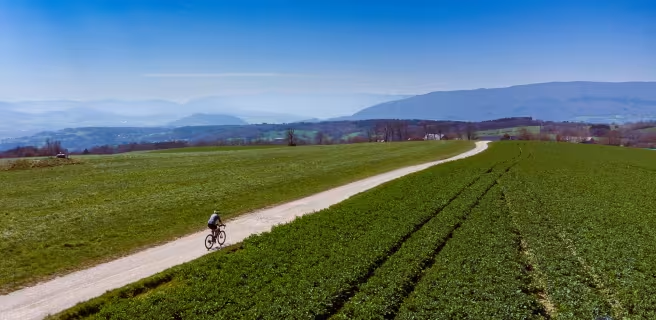
You'll then glide towards Mont Sion and Saint-Blaise on a network of pleasant undergrowth roads. Finally, you come out into a more open landscape. The descent is then on white gravel tracks: a gravel rider's paradise!
After rejoining the Chemin de Compostelle, you continue towards Frangy via Minzier and Chaumont. Small, undulating country roads then lead to Seyssel, a pretty town on the banks of the Rhône and on the ViaRhôna. Here you'll find a campsite, adapted accommodation and all the shops you need.
Seyssel / Saint-Jean-de-Chevelu

3 Seyssel / Saint-Jean-de-Chevelu

50 km
3 h 30 min
Difficult
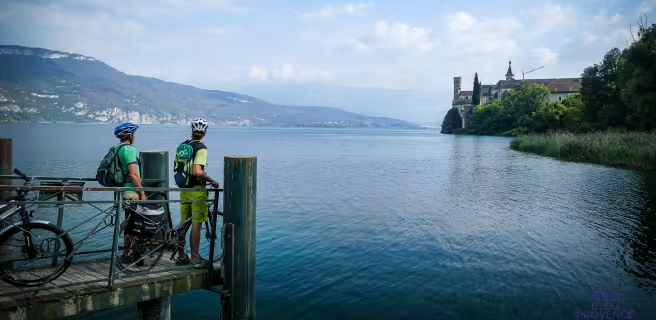
Departing from Seyssel, the route never really strays far from the Rhône, where it offers stunning views. It crosses the Chautagne region, making a detour to Lac du Bourget, the largest (on the French side) and one of the most beautiful Alpine lakes. It then reaches the village of Chanaz, nicknamed the "Little Savoyard Venice" due to its location on the Savière canal, which links the Rhône to Lac du Bourget.
Between Seyssel and Chanaz, first take the ViaRhôna, then leave it to reach Lac du Bourget, crossing the Chautagne plain, a protected wetland and natural area. From Chanaz, the road gradually diverges from the Rhône and ViaRhôna to reach Jongieux. This is the route of the Chemins du Soleil, the great mountain bike crossing of the Pre-Alps. The route leaves Jongieux, amidst vineyards and on the slopes of Mont du Chat, and descends to St Jean-de-Chevelu. Here we enter the Savoyard Avant-Pays, once known as the Savoyard Petit-Bugey.
It's a great day for sightseeing, because after Lac du Bourget and Chanaz, Jongieux, on the Compostelle trail and self-defined as an oenocyclo-tourist village, is well worth an extended stop.
Saint-Jean-de-Chevelu / Aiguebelette-le-Lac

4 Saint-Jean-de-Chevelu / Aiguebelette-le-Lac

43 km
3 h 00 min
Medium
At St Jean-de-Chevelu, follow the busy D1504 for a few hundred metres, before turning left towards Saint-Paul-sur-Yenne. You're still in the Savoyard Foreland. The vineyards have given way to increasingly hilly and wooded countryside. It's all very beautiful, and all the more tranquil for the fact that 60% of the route is on footpaths, in countryside or forest.
After heading south on the outskirts of Yenne, you begin the ascent of the northern slope of Mont Tournier (851 m). Its modest altitude conceals a not-so-easy ascent: almost 600 m of positive ascent spread over 10.5 km at an average gradient of 6%.
The climb is divided into two sections. The first (7.8 km) is on the slopes of Mont Tournier, at an average gradient of 6%. The open landscape offers breathtaking views of Mont du Chat and Montagne de l'Épine. The second part, 2.7 km long, starts at L'Abully, when you leave the D40 to take the D42, which climbs to the summit of Mont Tournier. You're now in the forest, on slopes of between 7.5% and 8.5%. The last kilometer, at 3.5%, brings this ascent to a gentle close.
The descent and the rest of the way to Saint-Maurice-de-Rotherens are on pleasant, rolling forest paths. The route then passes through Novalaise, before joining the shores of Lac d'Aiguebelette, near the A43 exit. Finally, it runs along the eastern shore of the lake, on a gravel surface dedicated to bicycles. End of section at Aiguebelette-le-Lac station.
Aiguebelette-le-Lac / Grenoble

5 Aiguebelette-le-Lac / Grenoble

54 km
3 h 00 min
Medium
This is the beautiful Chartreuse stage, which crosses the western part of the massif and the regional nature park. The first part of the route is on road, from Lépin-le-Lac to Les Échelles. You then drive below the massif de l'Épine, rising on quiet country roads above Lac d'Aiguebelette.
After passing through Attignat-Oncin, a rural, forested commune, you join the D921, which is a little busier as far as Les Échelles and Entre-Deux-Guiers. Here, you leave the P'tites Routes du Soleil® by road, which leads to Saint-Pierre-d'Entremont via the Col de Couz (626 m) and the Col des Égaux (958 m). This is an option that the more athletic and/or motivated can take to reach the heart of the Chartreuse massif. Instead, you can take the Via Chartreuse, linking Saint-Christophe-la-Grotte to Saint-Joseph-de-Rivière: a 17 km greenway, mainly made up of white paths, with numerous stops (natural areas, heritage, tastes) to discover the area.
From Saint-Joseph-de-Rivière to Voreppe and Grenoble, a dozen kilometers remain via the Col de la Placette (587 m). Not a very nasty climb, but on a fairly busy road. In Voreppe, join the pleasant cycle path along the banks of the Isère, where it's easy going. You can then return to Grenoble and your accommodation, unless you've decided to tackle the Vercors climb from Seyssinet-Pariset.
Grenoble / Herbouilly

6 Grenoble / Herbouilly

59 km
4 h 30 min
Very difficult
To start the first leg of your Vercors crossing, head for Seyssinet-Pariset, where the GVL (Grenoble / Villard-de-Lans) tramway used to run. Inaugurated in 1920 and in service until 1951, its final route linked the center of Grenoble to Villard-de-Lans, via Saint-Nizier-du-Moucherotte and Lans-en-Vercors. The route we recommend therefore follows the Via du Tram, mainly on tracks and crossing numerous engineering structures.
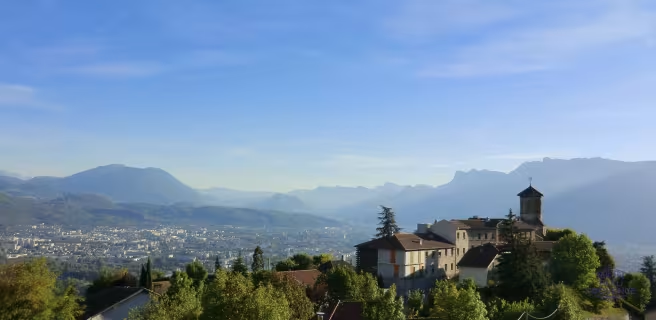
Alternatively, you can make the ascent by road from Seyssinet-Pariset. This tough climb is renowned for its superb panoramic views over the Grenoble area and the Belledonne mountain range. And if you want to skip the long climb up to the Vercors plateau, you can take the T64 and T65 buses, equipped with bike racks, from Grenoble bus station.
After Saint-Nizier-du-Moucherotte (1168 m), site of the former springboard for the Grenoble Olympics and the highest point of the climb from Grenoble, take the ViaVercors for around 25 kilometers to Corrençon-en-Vercors, via Lans-en-Vercors and Villard-de-Lans. What a surprise! The route is fun, especially in the first part, with curves, slope breaks and mostly gravel surfaces.
After Corrençon-en-Vercors, descend along forest roads to the D221, which comes from the Col d'Herbouilly. Then reach the Auberge-Refuge de Roybon, 500 m from the Herbouilly Nordic area, where you can spend the night in the forest.
Herbouilly / Die

7 Herbouilly / Die

59 km
4 h 00 min
Difficult
A stage entirely located in the Vercors Regional Nature Park. In the first part, we relied heavily on local resources to avoid the busy departmental roads.
From the Auberge-Refuge de Roybon, in Herbouilly, descend to the hamlet of Tourtre on a fairly technical forest track, then join La-Chapelle-en-Vercors on pleasant forest paths (2 or 3 pushes in the sand pits in case of rain), some of which are used by sled dogs in winter. From La-Chapelle-en-Vercors, continue to Vassieux-en-Vercors via the hamlet of Fouletier. From the village center, head towards the Col de Rousset, passing the Château-Loup gîte and the Raphaël Poirée biathlon stadium.
Cross the Col de St-Alexis (1222 m) to reach the Col de Rousset (1245 m). The 769 m-long Rousset tunnel requires a little lighting.
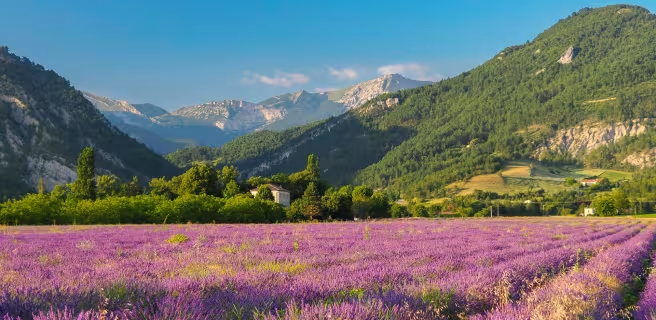
The Col de Rousset (1245 m) is a beautiful descent into the Diois region. When you switch to the Die side, the contrast is striking. You come across your first lavender fields, a foretaste of Provence. A final steep climb past Chamaloc to the Col de Romeyer before dropping down to the Diois capital.
Die / Valdrôme

8 Die / Valdrôme

60 km
4 h 45 min
Difficult
Watch out, there's still a long way to go!
We leave Die and cross the Diois, heading for the Buëch, on wide, rolling forest tracks. Lavender fields, vineyards, Scots pines... the landscape changes. You're in the southern Pre-Alps, and the atmosphere becomes Provençal.
From Die, reach Aix-en-Diois on the left bank of the Drôme. Cross over to the right bank and follow the Drôme meander as far as Saint-Roman. Near Menglon, you turn away from the river to begin the ascent of the Col du Pinet (1199 m) on a nice, rolling forest track.
At Miscon, head for the Drôme, which you reach at Pic de Luc (1085 m), south of Luc-en-Diois. You then cross the Claps de la Drôme, a spectacular rocky chaos, to progress along the left bank through a series of perched valleys via Beaumont-en-Diois and Charens to Valdrôme, at the end of this stage.
Valdrôme / Lagrand

9 Valdrôme / Lagrand

52 km
3 h 15 min
Difficult
From Valdrôme, take the road up to the old ski resort for a few kilometers. Leave it on your left and follow the network of trails that cross the border between the Drôme and Hautes-Alpes departments. You'll pass the Praboyer gite, which has been awarded the Accueil Vélo label, on a refurbished track.
From the gîte, you're in the northern part of the Baronnies Provençales regional nature park, and you'll reach the Oule valley at Montmorin via an old road, now accessible to hikers. Beware of a ten-metre-high climb! Large needle-shaped cliffs with views over the entire Oule valley.
From Montmorin, you then begin the fairly serious ascent to the Col des Tourettes (1126 m) between the Montagnes de Maraysse and Chauvet. From the pass, descend towards Ribeyret, on the road between Gap and Nyons. From Ribeyret, take the Chemins du Soleil mountain bike route to Montjay via the Col de Roure (1198 m) and the Col de Serre Larobe (1014 m). Quiet climbs in a charming setting, between photovoltaic installations and lavender fields.
From the Col de Serre Larobe, follow the balcony trail through forests and lavender fields. It leads to the two main difficulties of the day: the descent of the gorges d'Aumage and their ascent, where pushing is necessary. From Montjay, follow the valley of the Blaisance, a tributary of the Buëch. You pass Chanousse, perched on a spur overlooking the valley, and then reach Trescléoux, a village of old walls and pink tiles, steeped in sunshine and history. On the way to Lagrand, "Petite cité de caractère", with its superb panoramic views over the Buëch valley, we stop off at the Gite du Mont-Garde, which has been awarded the "Accueil Vélo" label.
Lagrand / Sisteron

10 Lagrand / Sisteron

66 km
4 h 45 min
Difficult
At Lagrand, we opted to go around the Montagne de Chabre, via Orpierre and the Col Saint-Jean (1159 m), to then follow the Méouge gorges. The ascent to the Col Saint-Jean, short but often close to 7%, takes you back into the Drôme and onto the P'tites Routes du Soleil® route. At the summit, you'll find a lovely oratory and, above all, a magnificent view.
After the pass, descend to Ballons, then cross the Col de la Croisette (927 m), and follow the Gorges de la Méouge.
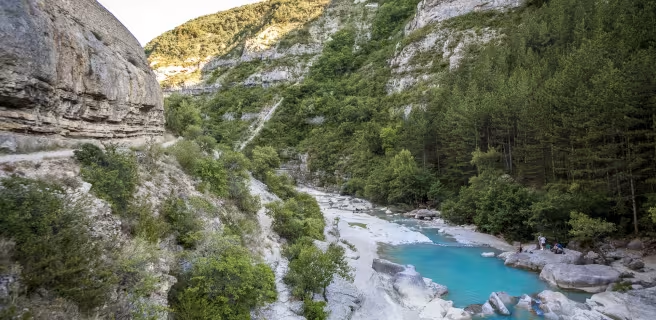
The Méouge winds its way through deep, winding gorges. The river winds through magnificent landscapes created by erosion. Huge boulders with ivory-colored strata, chaotic cliffs and scree, limestone tuffs make for an unforgettable visual experience.
After the Méouge joins the Buëch, head south-east towards Ribiers. From Ribiers, head for Sisteron on the Chemin de la Marquise path, which leads to the Sisteron citadel.
Sisteron / Digne-les-Bains

11 Sisteron / Digne-les-Bains

67 km
4 h 30 min
Very difficult
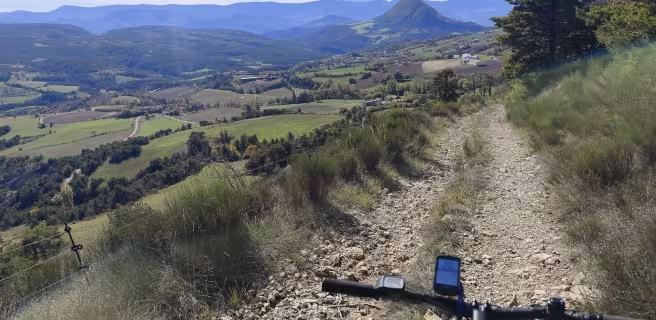
To link Sisteron to Digne-les-Bains, both major centers of accommodation and services for touring cyclists, we chose to go through the mountains rather than follow the banks of the Durance. It's a route that's more in keeping with the Gravel spirit, prettier too, and uses good rolling tracks to reach the Duyes valley and the Dignois region.
From Sisteron, the route reaches Entrepierres, along the Riou de Jabron. At Les Andrieux, it turns east to Saint-Geniez, located in the northern part of the Digne Pre-Alps and in the Haute-Provence geological nature reserve.
Then take the spectacular Route du Temps to Authon, nestled in a high-altitude valley in the heart of the Monges massif, equidistant between Lac de Serre-Ponçon and Digne-les-Bains. From Authon, take the road over the Col de Fontbelle (1304 m) and join the lovely forest tracks on the adret slope.
From Fontbelle, the trails are very rolling, with a succession of ascents and descents, including a few balcony sections, before descending more steeply towards the Duyes valley, for the most part on a small, traffic-free road. The landscape opens up in this perched valley. Shortly after Hautes-Duyes, past the friendly village of Thoard, the route continues uphill to a new pass. A small road and a track lead down to the Bléone valley. Be careful, it's a short, highly technical section over a good 50 m or so!
The junction with Digne-les-Bains, where you will follow and cross the Bléone, is via the cycle paths.
Digne-les-Bains / Barrême

12 Digne-les-Bains / Barrême

58 km
4 h 00 min
Very difficult
From Digne-les-Bains, head for Mézel, in the heart of the Asse valley. Further on, the route crosses the boundary of the Verdon Regional Nature Park and reaches Majastres, which has the distinction of being the least populated commune in the Alpes-de-Haute-Provence département.
After Majastres, a dry-stone path leads downhill to the Clue de la Melle, on the Riou d'Ourgeas. The route takes you through a fairly flat landscape: an area of pastureland, with lots of stones. You follow old paths and ford streams amid huge boulders. Before continuing downhill on an old stony road on the mountainside. Wilderness, incredible scenery, you're all alone in the world.
It's much greener before you reach a narrowing and an old path overlooking the gorge of the Riou d'Ourgeas ravine. The path, bordered by a wrought-iron railing, must have seen a lot of people.
Once you've crossed the gorge, you'll reach Barrême, a stopover on the Route Napoléon, so famous for its ammonite fossils that it gave its name to a period of the secondary era: the Barremian.
Barrême / Saint-Auban

13 Barrême / Saint-Auban

60 km
4 h 30 min
Very difficult
After Barrême, avoid the road by climbing to the summit of Clavoune (1338 m), popular with paragliders. The trails are very smooth as far as Saint-André-les-Alpes.
From Saint-André-les-Alpes, the route follows the eastern shore of Lac de Castillon, from its source to the dam (watch out for cars on the N202!). It crosses Saint-Julien-du-Verdon, perched on an almost-island of the lake, and then climbs towards Soleilhas, via Demandolx and the Col de Saint Barnabé.
Demandolx is a tiny village with exceptional views over the Castillon and Chaudanne lakes. As for the road to the Col de Saint-Barnabé (1365 m), it features a series of 8 hairpin bends at an average gradient of 6%, allowing you to gain height quickly, while enjoying superb panoramic views. The descent to Soleilhas is fairly short: just under four kilometers, with a few more beautiful switchbacks.
From Soleilhas, a bright village nestled in a valley surrounded on all sides by mountains and forest, follow the course of the Estéron, a tributary of the Var. It leads to Saint-Auban, an ancient village set in terraces at the foot of the immense Tracastel rock, famous for its Clue, a magnificent gorge much appreciated by canyoning enthusiasts.
Saint-Auban / Bézaudun-les-Alpes

14 Saint-Auban / Bézaudun-les-Alpes

48 km
3 h 30 min
Very difficult
Between Saint-Auban and Thorenc, there's still the Col de Bleine (1439 m) to cross. Five kilometers and a dozen switchbacks, on a gradient of between 6 and 7.5%. Three kilometers of descent bring you to Thorenc, also known as the "Suisse Provençale". This pleasant, climatic resort in the Grasse hinterland is situated on a vast, high-altitude plateau, amid wooded landscapes of fir and poplar, surrounded by a splendid mountain backdrop that keeps it sheltered from the Alpine winds.
From Thorenc, the route follows the course of the Lane, before continuing northeast towards the resort of Gréolières-les-Neiges. The route passes at the foot of the Montagne du Cheiron, culminating at the cime du Cheiron (1778 m), on whose slopes ski runs have been laid out.
You're very close to Nice, but it's so wild! Unforgettable sea and mountain views... One of our favorites, but beware, it's a bit mountain-bikey, even if it's on Gravel. For those who hesitate, there's an alternative via the very pretty route de la clue de Gréolières: passage along a ledge, through rocks, through the pretty village of Gréolières, with a view of the sea.
At the end of this splendid stage, you reach the foot of the village of Bézaudun-les-Alpes.
Bézaudun-les-Alpes / Nice

15 Bézaudun-les-Alpes / Nice

43 km
3 h 00 min
Medium
From Bézaudun-les-Alpes, join the Var valley, passing through Le Broc, a charming village perched on a rocky spur overlooking the confluence of the Var and Estéron rivers. You're in the north and not far from the famous "baous", the most famous of which is Saint-Jeannet, well known to climbers.
After Carros, another beautiful medieval village dominated by its 12th-century castle, the route crosses the Var and heads north along the busy Grenoble road.
After three unpleasant kilometers of traffic, you take a sharp right to juggle the tracks, paths and roads of the Nice hinterland.
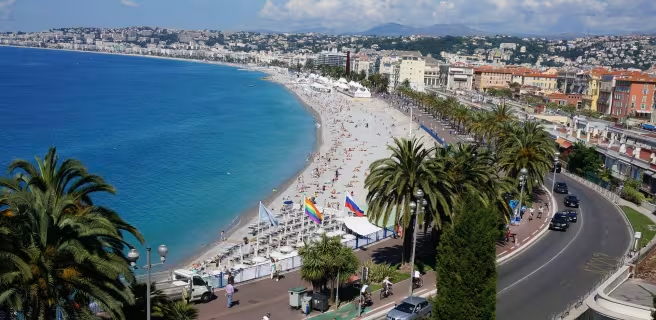
After following the Banquière to its junction with the Paillon, follow the latter to the sea and the Promenade des Anglais. Well done, you've done it!
Afficher les étapes